

Atelier DURDAN News
- Thread starter Atelier Durdan
- Start date


Atelier Durdan
Forum GOD!
We are organizing an exceptional 15% discount on all of our razors from November 23 to 30.
Yours sincerely,
Augustin
Yours sincerely,
Augustin
Atelier Durdan
Forum GOD!
Hello everyone,
I wanted to give you an update on the latest developments in my workshop:
Collaboration with a woodturner
I am currently working with a skilled woodturner to offer a new range of razor handles and shaving brushes combining wood and metal. My goal is to maintain my signature materials and finishes while providing an additional selection of fine woods for those who appreciate this noble material.

High-end wooden cases
In the same spirit, I also want to offer luxurious wooden cases that surpass the quality of previous ones. I am in discussions with a specialist to design an exceptional case that will truly enhance my razors.
Collaborative razor comparison platform
I am developing a platform that allows users to rate and compare razors based on their personal experience. The main idea is to establish a smoothness rating (which is, of course, subjective), with an average score calculated from user reviews to rank each razor in relation to others. The project is already available online in French, and I would love to get your feedback to improve it.
https://www.reliferazor.com/
Feel free to share your thoughts and suggestions—any input is greatly appreciated!
See you soon, and happy shaving!
I wanted to give you an update on the latest developments in my workshop:
Collaboration with a woodturner
I am currently working with a skilled woodturner to offer a new range of razor handles and shaving brushes combining wood and metal. My goal is to maintain my signature materials and finishes while providing an additional selection of fine woods for those who appreciate this noble material.
High-end wooden cases
In the same spirit, I also want to offer luxurious wooden cases that surpass the quality of previous ones. I am in discussions with a specialist to design an exceptional case that will truly enhance my razors.
Collaborative razor comparison platform
I am developing a platform that allows users to rate and compare razors based on their personal experience. The main idea is to establish a smoothness rating (which is, of course, subjective), with an average score calculated from user reviews to rank each razor in relation to others. The project is already available online in French, and I would love to get your feedback to improve it.
https://www.reliferazor.com/
Feel free to share your thoughts and suggestions—any input is greatly appreciated!
See you soon, and happy shaving!
Atelier Durdan
Forum GOD!
THE ALLIANCE OF METAL AND WOOD: A NEW CHAPTER FOR ATELIER DURDAN
This week marks a significant evolution in our range with the integration of wood into our creations. After months of development, I am pleased to present our first handles and shaving brushes incorporating walnut and olive wood, two local species with exceptional characteristics.
A Decisive Encounter
The story of this new line began at the Made in France Exhibition in Paris, where our stand was adjacent to that of Guillaume, a woodturning craftsman specializing in pens. You can visit his website if interested (https://confectionbois.fr/en/). The similarity of our approach and our shared vision of excellence in craftsmanship quickly created a bond between us. We were so aligned in our communication that several visitors thought we were one and the same company! This misunderstanding was a clear sign that a collaboration was not only possible but seamless.
The Technical Challenge
Integrating wood into our steel creations wasn't simply an aesthetic fancy, but a logical step in our quest for noble materials. However, the precision required for our metal pieces necessitated substantial preparatory work. We designed specific tooling allowing Guillaume to turn handles and shaving brushes to the exact dimensions of our steel components.
One of the major challenges was establishing common work references between our two workshops. The creation of dedicated tools eliminated superfluous adjustments and optimized production while maintaining our standard of excellence.
The Choice of Wood Species
For this first series, we selected walnut and olive, two local woods with complementary properties:
An Evolution, Not a Revolution
These new products do not represent a shift in our philosophy, but rather its natural extension. They will become part of our permanent range, demonstrating our continued commitment to noble materials and excellence in craftsmanship.
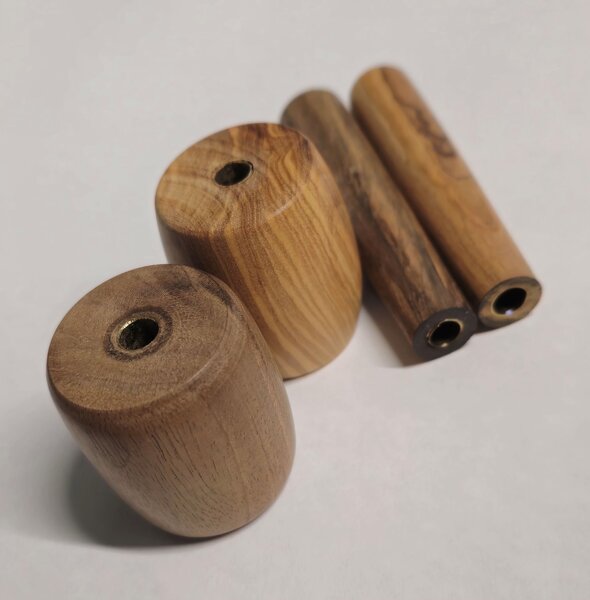
The first prototypes are currently in the testing phase, and I cannot resist sharing with you some pictures taken directly on Guillaume's wood lathe. These raw images capture the very essence of our approach: the transformation of raw materials into exceptional objects.
Next week, I will unveil the first finished pieces. In the meantime, I remain available for any questions about this new adventure that combines steel and wood in the same piece of French craftsmanship.
Augustin

This week marks a significant evolution in our range with the integration of wood into our creations. After months of development, I am pleased to present our first handles and shaving brushes incorporating walnut and olive wood, two local species with exceptional characteristics.
A Decisive Encounter
The story of this new line began at the Made in France Exhibition in Paris, where our stand was adjacent to that of Guillaume, a woodturning craftsman specializing in pens. You can visit his website if interested (https://confectionbois.fr/en/). The similarity of our approach and our shared vision of excellence in craftsmanship quickly created a bond between us. We were so aligned in our communication that several visitors thought we were one and the same company! This misunderstanding was a clear sign that a collaboration was not only possible but seamless.
The Technical Challenge
Integrating wood into our steel creations wasn't simply an aesthetic fancy, but a logical step in our quest for noble materials. However, the precision required for our metal pieces necessitated substantial preparatory work. We designed specific tooling allowing Guillaume to turn handles and shaving brushes to the exact dimensions of our steel components.
One of the major challenges was establishing common work references between our two workshops. The creation of dedicated tools eliminated superfluous adjustments and optimized production while maintaining our standard of excellence.
The Choice of Wood Species
For this first series, we selected walnut and olive, two local woods with complementary properties:
- Walnut: Dense and stable, it offers remarkable resistance to moisture while presenting dark veins of undeniable elegance.
- Olive wood: Its tight grain and unique patterns make it an exceptional wood, while its richness in natural oils gives it natural water resistance, an essential quality for a shaving accessory.
An Evolution, Not a Revolution
These new products do not represent a shift in our philosophy, but rather its natural extension. They will become part of our permanent range, demonstrating our continued commitment to noble materials and excellence in craftsmanship.
The first prototypes are currently in the testing phase, and I cannot resist sharing with you some pictures taken directly on Guillaume's wood lathe. These raw images capture the very essence of our approach: the transformation of raw materials into exceptional objects.
Next week, I will unveil the first finished pieces. In the meantime, I remain available for any questions about this new adventure that combines steel and wood in the same piece of French craftsmanship.
Augustin
Atelier Durdan
Forum GOD!
Last week, I shared our project of integrating wood into our creations. Today, after numerous tests and adjustments, I'm pleased to present the first concrete results of this venture.
From Prototypes to Finished Products
The initial prototypes we sketched are now finished products. The alignment between hand-turned wooden pieces and our CNC-machined metal parts wasn't the simplest challenge, but the result is conclusive.
What We're Offering Today
We've finalized two configurations that we find particularly successful:

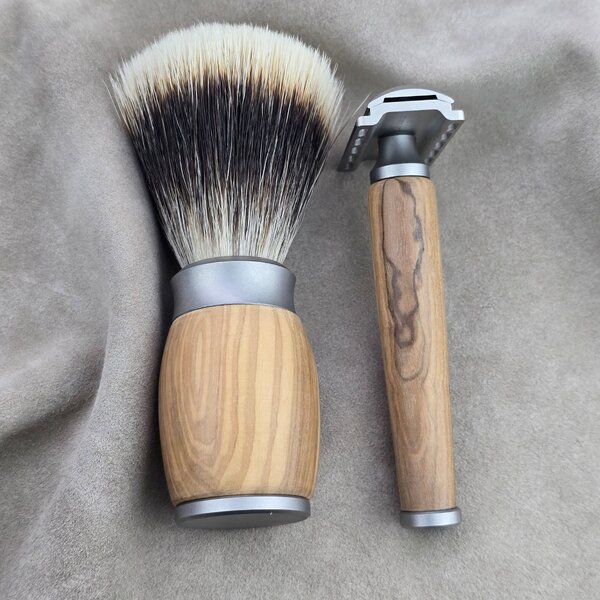
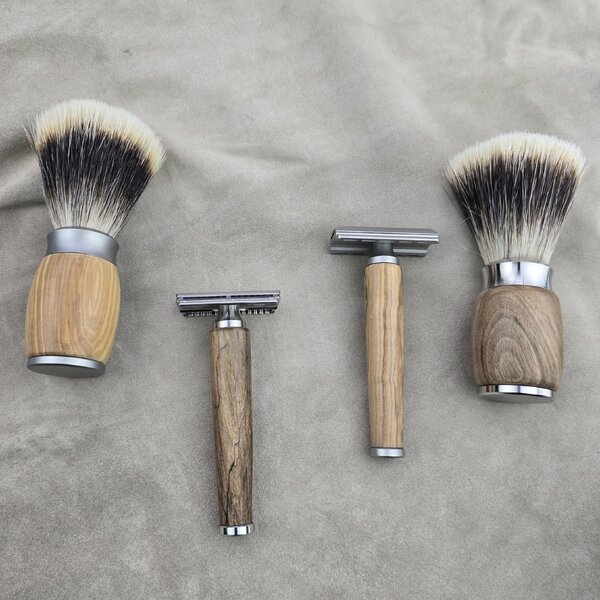
We've been particularly attentive to the balance of each piece. The upper ring of the brush offers a natural grip for the fingers, which greatly facilitates handling when creating lather.
An Evolving Approach
This project remains a continuous exploration for us. User feedback will be valuable in refining and perhaps expanding our offering to other wood species in the future.
I remain available for any questions or suggestions about these new items. Your impressions will help us progress in this new direction.
Best regards, Augustin
From Prototypes to Finished Products
The initial prototypes we sketched are now finished products. The alignment between hand-turned wooden pieces and our CNC-machined metal parts wasn't the simplest challenge, but the result is conclusive.
What We're Offering Today
We've finalized two configurations that we find particularly successful:
- Our N°7 now features a walnut handle with expressive grain patterns that elegantly contrast with the machined stainless steel.
- The Maurice is adorned with a boxwood handle, whose light and warm color perfectly complements the sandblasted stainless steel finish.
- Our shaving brush features a double band natural hair knot (21mm knot with SHD density, 10-15% denser), mounted on a handle that matches the razor of your choice.
- For those who want to see more, I made a presentation video here

Présentation manche et blaireaux en bois
Découvrez nos nouvelles créations où l'acier rencontre le bois noble. Cette vidéo présente nos rasoirs N°7 et Le Maurice avec leurs nouveaux manches en noyer...www.youtube.com
We've been particularly attentive to the balance of each piece. The upper ring of the brush offers a natural grip for the fingers, which greatly facilitates handling when creating lather.
An Evolving Approach
This project remains a continuous exploration for us. User feedback will be valuable in refining and perhaps expanding our offering to other wood species in the future.
I remain available for any questions or suggestions about these new items. Your impressions will help us progress in this new direction.
Best regards, Augustin
Atelier Durdan
Forum GOD!
Hello to all enthusiasts,

Today marks a double event for Atelier Durdan: my personal birthday and the official launch of our new range of noble wood handles and shaving brushes.
As mentioned last week, this new line was born from a collaboration with a local woodturning craftsman. After several prototypes and adjustments, we are now ready to offer our stainless steel handles and brushes with custom finishes, paired with walnut or olive wood.
The alignment between hand-turned wooden pieces and our CNC-machined metal parts presented a real challenge, but the result meets our high standards. Special attention was paid to the ergonomics and balance of each piece.
Limited-Time Special Offer (until April 14th)
To celebrate both this new product line and my birthday, I'm offering:
I remain available for any questions about these new creations or to discuss your preferences between walnut and olive wood.
Best regards,
Augustin
Today marks a double event for Atelier Durdan: my personal birthday and the official launch of our new range of noble wood handles and shaving brushes.
As mentioned last week, this new line was born from a collaboration with a local woodturning craftsman. After several prototypes and adjustments, we are now ready to offer our stainless steel handles and brushes with custom finishes, paired with walnut or olive wood.
The alignment between hand-turned wooden pieces and our CNC-machined metal parts presented a real challenge, but the result meets our high standards. Special attention was paid to the ergonomics and balance of each piece.
Limited-Time Special Offer (until April 14th)
To celebrate both this new product line and my birthday, I'm offering:
- 10% discount on all wooden handles and shaving brushes
- Additional 10% off on the entire order when purchasing 3 or more items (across all categories)
I remain available for any questions about these new creations or to discuss your preferences between walnut and olive wood.
Best regards,
Augustin

Johnny Bravo
Love Guru to the stars.
Happy birthday 
Atelier Durdan
Forum GOD!
After several months of research and development, I am pleased to announce the return of wooden boxes to our catalog. This is an entirely reimagined new generation, the result of a long quest for perfection.
Genesis of a New Beginning
Some of you may remember the first wooden boxes we produced directly in our workshop. While the concept was promising, the daily reality of a mechanical workshop (complex sourcing of fine wood, omnipresent dust) made production difficult to maintain over time. Our last attempt, based on commercial boxes adapted with our custom foam inserts, unfortunately did not meet our standards in terms of finish and durability.
I therefore decided to start from scratch, with a clear ambition: to create a case worthy of our razors, without compromising on quality.
A Collaboration of Excellence
After extensive research, I established a partnership with a French company specializing in custom box manufacturing. Several exchanges and prototypes later, I recently received this model that I am proud to present to you today.
This box is entirely machined from solid walnut, reminiscent of our V2 versions of the past but with a satin clear varnish finish that enhances the natural grain of the wood. The hinges and closures are of Swiss origin, in a silver version — simple but exemplary in reliability.
A Modular and Customizable Design
The dimensions (130 x 200 x 60 mm) offer generous volume to store much more than a simple shaving set. I have particularly worked on the interior layout:
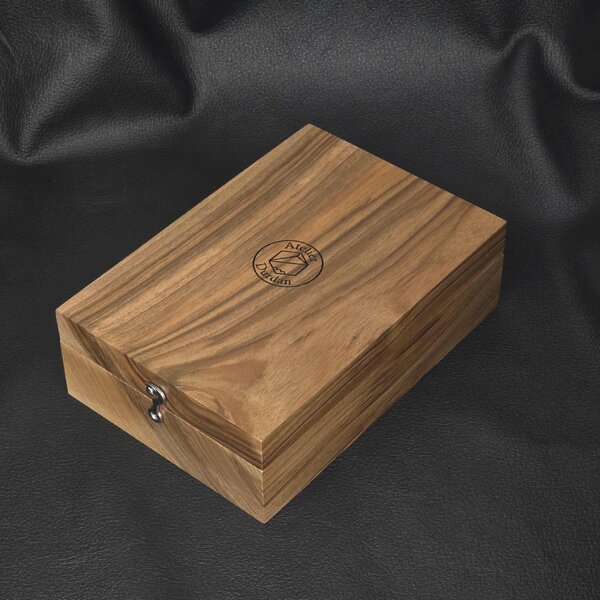

In the photos, you can see an example of an arrangement with a shaving set, but the possibilities are virtually endless. I will work personally with each client to adapt the interior to their current or future collection.
Practical Details
These boxes will be produced exclusively to order, with our usual manufacturing time (3 to 6 weeks depending on our order book). For this first series, only walnut will be offered — other wood species may be considered later depending on demand.
They will be available at a price of €388, reflecting the quality of materials, precision machining, and the fully customizable nature of each piece.
A Return to Our Roots
This project marks for me a return to the very essence of Atelier Durdan: the constant pursuit of excellence, the refusal to compromise, and the alliance of noble materials. These boxes are not merely accessories, but true treasure chests designed to enhance and protect your shaving instruments for years to come.
For any questions or to discuss a custom box project, please do not hesitate to contact me directly.
Augustin
Genesis of a New Beginning
Some of you may remember the first wooden boxes we produced directly in our workshop. While the concept was promising, the daily reality of a mechanical workshop (complex sourcing of fine wood, omnipresent dust) made production difficult to maintain over time. Our last attempt, based on commercial boxes adapted with our custom foam inserts, unfortunately did not meet our standards in terms of finish and durability.
I therefore decided to start from scratch, with a clear ambition: to create a case worthy of our razors, without compromising on quality.
A Collaboration of Excellence
After extensive research, I established a partnership with a French company specializing in custom box manufacturing. Several exchanges and prototypes later, I recently received this model that I am proud to present to you today.
This box is entirely machined from solid walnut, reminiscent of our V2 versions of the past but with a satin clear varnish finish that enhances the natural grain of the wood. The hinges and closures are of Swiss origin, in a silver version — simple but exemplary in reliability.
A Modular and Customizable Design
The dimensions (130 x 200 x 60 mm) offer generous volume to store much more than a simple shaving set. I have particularly worked on the interior layout:
- Custom foam inserts for precise and secure positioning of each element
- Possibility of integrating multiple storage layers in depth
- Complete personalization of the arrangement according to your specific needs
- Dedicated space in the lid for workshop cards and other documents, ideal for collectors
In the photos, you can see an example of an arrangement with a shaving set, but the possibilities are virtually endless. I will work personally with each client to adapt the interior to their current or future collection.
Practical Details
These boxes will be produced exclusively to order, with our usual manufacturing time (3 to 6 weeks depending on our order book). For this first series, only walnut will be offered — other wood species may be considered later depending on demand.
They will be available at a price of €388, reflecting the quality of materials, precision machining, and the fully customizable nature of each piece.
A Return to Our Roots
This project marks for me a return to the very essence of Atelier Durdan: the constant pursuit of excellence, the refusal to compromise, and the alliance of noble materials. These boxes are not merely accessories, but true treasure chests designed to enhance and protect your shaving instruments for years to come.
For any questions or to discuss a custom box project, please do not hesitate to contact me directly.
Augustin
Atelier Durdan
Forum GOD!
This week, I'd like to share with you the recent evolutions made to our leather cases. Far from being simple cosmetic adjustments, these modifications reflect our philosophy of continuous improvement and my desire to deepen traditional leatherworking techniques.
From Engraving to Hot Stamping
The first evolution concerns the marking of our logo on the snap button. Previously, we machined these small metal pieces directly on our CNC center. While the result was satisfactory, this method presented several drawbacks:
The result is a brilliant, clean, and durable impression that doesn't compromise the integrity of the button. For upcoming series, the marking will be done in silver, to match our existing color compositions.
Return to Traditional Gestures
The second major evolution concerns the cutting and punching of the cases. After several months of use, I made the decision to abandon automated methods in favor of entirely manual work.
This choice is not motivated by a simple search for authenticity, but by very pragmatic considerations:
Immersion in the Art of Leatherworking
This evolution is part of a broader approach to deepening leatherworking techniques. Beyond improving our existing products, it's also an exploration of new possibilities for future creations.
The skills acquired in developing precise templates and manual punching techniques open the door to more ambitious projects that I'm eager to share with you in the coming months.
A Project in Development: The Ideal Toiletry Bag
Among these projects is a toiletry bag specifically designed for traditional shaving enthusiasts. I envision an accessory with dedicated compartments for each essential element of your ritual.
And this is where I'd like to ask for your input: what would be, in your opinion, the ideal shaving bag? What compartments would be essential? What size would you prefer? Would you favor a compact format for travel or a more generous one for daily use?
Your feedback will be invaluable in shaping this future project according to your actual needs.
In Conclusion
These evolutions of the leather cases, though subtle, illustrate our constant commitment to artisanal excellence. The price remains unchanged, true to our philosophy of perfecting our creations without impact on our customers.
I will very soon share detailed photos of these manufacturing processes - from manual cutting to stitching, to the finished products.
Please feel free to share your thoughts on these evolutions or your suggestions for the future shaving bag in the comments.
Augustin


From Engraving to Hot Stamping
The first evolution concerns the marking of our logo on the snap button. Previously, we machined these small metal pieces directly on our CNC center. While the result was satisfactory, this method presented several drawbacks:
- Inconsistent repeatability due to dimensional variations in the buttons
- Structural weakening of the already relatively thin buttons
- Technical complexity disproportionate to the desired result
The result is a brilliant, clean, and durable impression that doesn't compromise the integrity of the button. For upcoming series, the marking will be done in silver, to match our existing color compositions.
Return to Traditional Gestures
The second major evolution concerns the cutting and punching of the cases. After several months of use, I made the decision to abandon automated methods in favor of entirely manual work.
This choice is not motivated by a simple search for authenticity, but by very pragmatic considerations:
- Elimination of leather detachment problems during machine cutting
- Resolution of material lifting during automated punching
- Simplification of the process for one-off productions
- Superior finish quality, with each cut being carefully controlled
Immersion in the Art of Leatherworking
This evolution is part of a broader approach to deepening leatherworking techniques. Beyond improving our existing products, it's also an exploration of new possibilities for future creations.
The skills acquired in developing precise templates and manual punching techniques open the door to more ambitious projects that I'm eager to share with you in the coming months.
A Project in Development: The Ideal Toiletry Bag
Among these projects is a toiletry bag specifically designed for traditional shaving enthusiasts. I envision an accessory with dedicated compartments for each essential element of your ritual.
And this is where I'd like to ask for your input: what would be, in your opinion, the ideal shaving bag? What compartments would be essential? What size would you prefer? Would you favor a compact format for travel or a more generous one for daily use?
Your feedback will be invaluable in shaping this future project according to your actual needs.
In Conclusion
These evolutions of the leather cases, though subtle, illustrate our constant commitment to artisanal excellence. The price remains unchanged, true to our philosophy of perfecting our creations without impact on our customers.
I will very soon share detailed photos of these manufacturing processes - from manual cutting to stitching, to the finished products.
Please feel free to share your thoughts on these evolutions or your suggestions for the future shaving bag in the comments.
Augustin
Atelier Durdan
Forum GOD!
After three weeks of silence, I'm back with a topic that deserves this media pause: the development of a brand new adjustable razor, a project I've been working on for several months.
Genesis of the Project
The initial idea was simple in its formulation, but complex in its execution: to create an adjustable razor with a simple and durable mechanism. Not wanting to venture into the path of a traditional adjustable safety razor, which requires numerous parts and would tie up too many of our limited machining resources, I explored another direction.
My conviction is that adjusting the blade exposure constitutes the ideal parameter to allow everyone to find their optimal shaving level. This is the path I followed.
The Choice of AC Blades
To integrate an effective adjustment mechanism, I opted for AC blades, known for their thinness. This characteristic frees up valuable space to house the adjustment mechanism without compromising the overall ergonomics of the razor.
Beyond this technical aspect, I must admit that these blades count among my personal favorites — an additional reason that motivated this choice.
The First Attempts: Constructive Failure
My first approach was not conclusive. I had imagined a system where the user could manually adjust the position of the cap on different notched positions, thus modulating the blade exposure.
Unfortunately, even when working on the angles, this solution did not provide intuitive and reliable adjustment. It was necessary to go back to the drawing board.
The Slide Solution
In a second phase, I explored a cap translation system via a slide. This approach was not without risk: the danger of jamming (mechanical blockage) is real on this type of mechanism.
The major technical challenge lay in the clearance to be maintained — that subtle balance where too tight an adjustment prevents any movement, while too much play promotes jamming.
After several iterations and modifications, I finally assembled a first functional prototype. It still has some imperfections — occasional slight blockages during adjustment and aesthetics to refine — but the shaving performance has proven excellent.

Technical Characteristics
For this new razor, I drew inspiration from La Faulx for the shaving angles, but with a gap (space between the blade and the comb) of 1 mm.
The adjustment range extends from -0.15 mm to +0.2 mm of blade exposure. Depending on the chosen setting, the gap varies slightly, but in a subtle way. The adjustment is intuitive enough to be modified even in the middle of shaving, with a BBS (Baby Butt Smooth - perfectly smooth shave) consistently achieved.
Towards Version 2.0
Encouraged by these initial promising results, I'm planning a significant update for version 2, scheduled for the end of May. On the agenda:
This project represents a new direction for the workshop, with the ambition to offer a modular razor without sacrificing the mechanical simplicity and durability that characterize our creations.
You can discover this prototype in action in the video below which demonstrates the operation of the adjustment mechanism. The photos will also allow you to appreciate the details of this first version, with its qualities and imperfections that we will correct for V2.
I'm eager to hear your impressions on this concept or any suggestion that could inform the final development phase.
Augustin
video here : https://www.youtube.com/shorts/WsKdDd9FluU
Genesis of the Project
The initial idea was simple in its formulation, but complex in its execution: to create an adjustable razor with a simple and durable mechanism. Not wanting to venture into the path of a traditional adjustable safety razor, which requires numerous parts and would tie up too many of our limited machining resources, I explored another direction.
My conviction is that adjusting the blade exposure constitutes the ideal parameter to allow everyone to find their optimal shaving level. This is the path I followed.
The Choice of AC Blades
To integrate an effective adjustment mechanism, I opted for AC blades, known for their thinness. This characteristic frees up valuable space to house the adjustment mechanism without compromising the overall ergonomics of the razor.
Beyond this technical aspect, I must admit that these blades count among my personal favorites — an additional reason that motivated this choice.
The First Attempts: Constructive Failure
My first approach was not conclusive. I had imagined a system where the user could manually adjust the position of the cap on different notched positions, thus modulating the blade exposure.
Unfortunately, even when working on the angles, this solution did not provide intuitive and reliable adjustment. It was necessary to go back to the drawing board.
The Slide Solution
In a second phase, I explored a cap translation system via a slide. This approach was not without risk: the danger of jamming (mechanical blockage) is real on this type of mechanism.
The major technical challenge lay in the clearance to be maintained — that subtle balance where too tight an adjustment prevents any movement, while too much play promotes jamming.
After several iterations and modifications, I finally assembled a first functional prototype. It still has some imperfections — occasional slight blockages during adjustment and aesthetics to refine — but the shaving performance has proven excellent.
Technical Characteristics
For this new razor, I drew inspiration from La Faulx for the shaving angles, but with a gap (space between the blade and the comb) of 1 mm.
The adjustment range extends from -0.15 mm to +0.2 mm of blade exposure. Depending on the chosen setting, the gap varies slightly, but in a subtle way. The adjustment is intuitive enough to be modified even in the middle of shaving, with a BBS (Baby Butt Smooth - perfectly smooth shave) consistently achieved.
Towards Version 2.0
Encouraged by these initial promising results, I'm planning a significant update for version 2, scheduled for the end of May. On the agenda:
- Complete redesign
- Optimized repositioning of the slide
- Significant improvement of the adjustment button
- Elimination of occasional blocking problems
This project represents a new direction for the workshop, with the ambition to offer a modular razor without sacrificing the mechanical simplicity and durability that characterize our creations.
You can discover this prototype in action in the video below which demonstrates the operation of the adjustment mechanism. The photos will also allow you to appreciate the details of this first version, with its qualities and imperfections that we will correct for V2.
I'm eager to hear your impressions on this concept or any suggestion that could inform the final development phase.
Augustin
video here : https://www.youtube.com/shorts/WsKdDd9FluU